Skip to content
Emergency shutdown board for a flow-battery stack

Projects / Industrial automation and embedded control

Flow battery safety shutdown board

Independent safety shutdown board for a flow-battery stack: voltage and current measurement, external emergency input, relay shutdown control and latched fault state until manual reset.

Task

What had to be solved

The task was to make a separate protection node for a laboratory flow-battery stack. The main controller can manage bench modes, but shutdown protection is better placed in an independent circuit so firmware failure or wrong settings do not break the stop mechanism.

Result

What the project reached

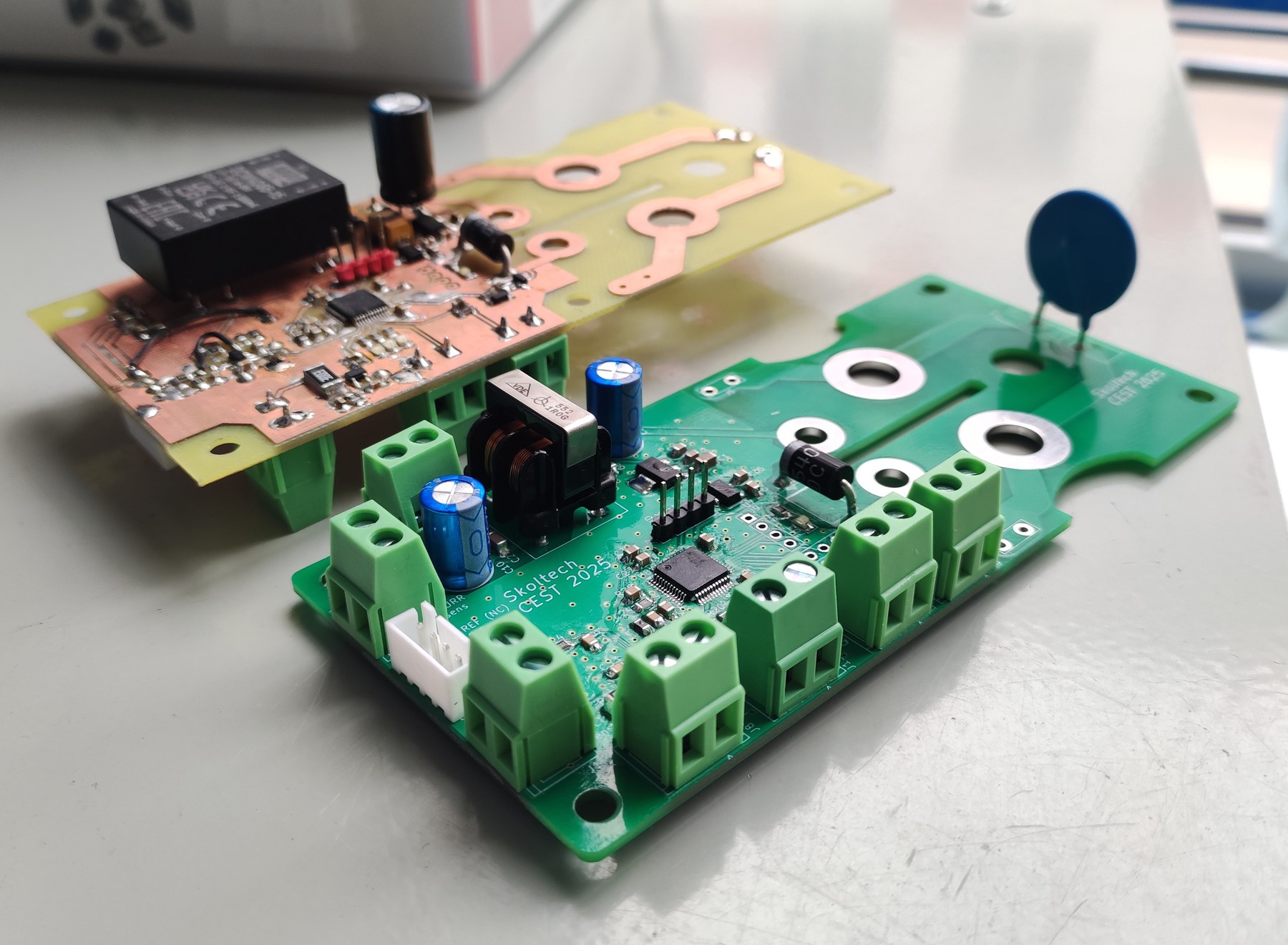
A specialized safety shutdown device was developed. The board measures current and voltage, monitors an external emergency input, opens the power circuit through a relay and latches the fault state until the operator performs a manual reset.

Emergency shutdown board for a flow-battery stack
Emergency shutdown board for a flow-battery stack installed in the setup, with 70 V and 250 A limits

Project materials

Photos and working materials

Prototype of the flow-battery stack emergency shutdown board
Testing the flow-battery stack emergency shutdown board

Engineering context

Important constraints

Protection logic has to be separated from the main experiment logic.

After a fault, the stack must not switch back on automatically without checking the bench.

For an experimental setup, simple diagnostics and a clear manual reset are important.

Protection thresholds can be adjusted for a specific bench, current sensor and required margin.

Work done

What was included

STM32F103 safety-shutdown board circuit.

Voltage and current measurement inputs with analog conditioning.

External shutdown-signal input and manual reset button.

Relay control through a separate output.

Firmware with ADC calibration, physical-unit conversion and EWMA filtering.

LED indication, SWD and UART debugging interfaces.

Details

Engineering project description

Independent protection loop

The board works as a separate safety layer. It is not responsible for the whole experiment; it has a narrow task: detect a dangerous state and break the power circuit.

Latched fault state

The fault state is held until manual reset. This approach forces the operator to check the reason for shutdown instead of getting an automatic restart immediately after the fault sign disappears.

Bench integration

The device was integrated into the setup as a protection module: the main system continues to control the experiment, while the shutdown board remains an independent current, voltage and external-emergency monitor.

Contact

Discuss your engineering task

Contact us by email. We discuss custom electronics and automation tasks remotely with companies, labs, small businesses and individual customers worldwide.